


Find out how to turn noise into ideas, which are meant for organizations that care about reliability, scale, and measurable ROI, and long-term content marketing success.
This altered passage is from Devin Bramhall’s B2B Content Marketing Strategy, ©2025, and it is used with the permission from Kogan Page Ltd.
It’s not enough for a brand to be a megaphone anymore; modern content planning is about more than that.
A modern content strategy that works is a hybrid approach aimed to develop community around shared experiences, foster lasting relationships, and generate genuine trust and influence. It’s about leaning into individualism inside niche communities by developing material that resonates with individuals and small groups better than trying to appeal to the masses.
And it’s clearly not a pursuit of ubiquity, in the manner businesses used to accomplish it by building a dominant presence on any platform and community area. Actually, it’s about taking smaller actions to accomplish greater results. Playing a helping role in the community sometimes by uplifting others. It’s about developing relationships that stimulate action better force it. Mostly, it’s about developing frameworks and principles to guide and assess your actions so you can build your own “playbook” that works for your organization and community.
At Softech Study, a leading Digital Marketing and IT Training Institute in Delhi NCR, we believe that modern content marketing strategy is not just about publishing—it’s about building trust, community, and measurable ROI.
Principles Of Good Content Marketing Strategy
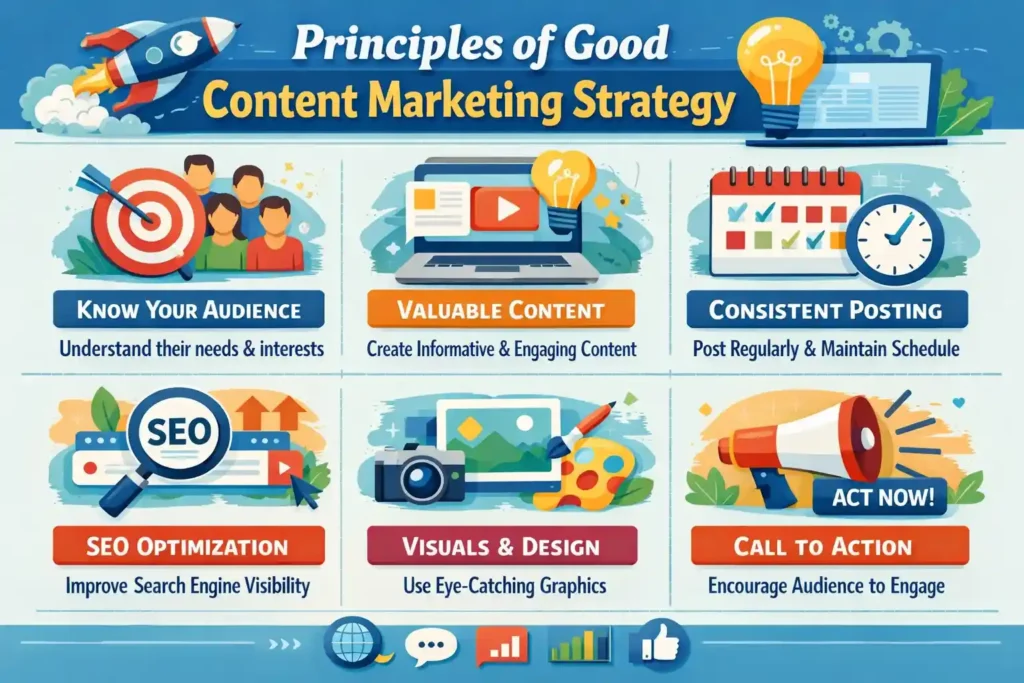
Content marketing exists to assist corporate goals by alleviating customer pain points. It accomplishes this through teaching and relationship-building:
Education draws potential consumers and influencers by giving immediate value in the form of short-term solutions (awareness and affinity).
Establishing trust helps your brand to become a continuous part of your community’s lives by understanding their phrases, empathizing with their concerns, and solving their queries (nurture and engage).
Relationship formation creates congruence between outward promises and internal experiences – the product delivers on the desires set by content (to convert, grow LTV, and upsell).
The idea is to help first and sell second – at which time clients often feel they made conclusions independently. They become eager to stake in both the goods and the relationship. This is how content marketing works naturally based on human behavior.
It’s also the information you already know. Content marketing teams directed by the following concepts consistently deliver greater outcomes.
Create Unique Advantage
No other firm exists with your identical combination of items, people, and resources. Your first responsibility as a marketers is to recognize what you actually have that can be exploited for growth.
This may be your founder’s network, your CMO’s big LinkedIn following that coincides with your target consumers, or a product function that answers a previously neglected need. It can be an up coming conference where your CEO is talking to 300 decision-makers who convene only once each year.
Other advantages can include:
- Budget, software, and technical resources.
- Existing audiences, mailing lists, or content archives.
- Market position (whether it be as a setup leader or disruptive newcomer).
- Opportunistic events like financing announcements or crucial hiring.
- Your own specific talents, experiences, and connections.
The purpose is to design a content strategy that:
- Competitors can’t readily imitate because they lack your distinctive advantages.
- Generates exponential impact by using opportunistic occurrences, efficient execution, and actions that serve numerous outcomes simultaneously.
- Is scalable with repetitive pieces that compound over time and can increase with reasonable ease. A excellent instance comes from Gong, the income intelligence platform. While competitors concentrated on traditional SaaS marketing playbooks, Gong utilized their unique advantage: accessibility to millions of sales discussions and the data patterns within them. By sharing the insights from this exclusive data, they developed content no competition could reproduce, positioning themselves as the ultimate source of sales information while simultaneously showcasing their product’s value.
Serve Outcomes It Can Logically Impact (Better Than Other Approaches)
Strategy that serves corporate goals does must to be measured to ensure that it’s serving those results, and ideally, how well it succeeds them. Yes, I’m talking about ROI.
The benefits of having simply defined, quantitative, time-based results is twofold:
- It helps you focus down tactics.
- It gives you a goal to “bump up against” to herb extract learnings for continual growth. This idea encourages you to evaluate each prospective marketing effort against a simple standard: Is this the greatest method to attain the business outcome we desire, or are we doing it since it’s the way we have eternally done it?
Can Be Executed With Existing Resources
A strategy is just as good as your capacity to execute it.
Your concept is only effective if you include in all constraints, that include budget and resources. If you come up with a wonderful idea that you know is unlikely to get funded, then it’s not wonderful in the environment in which you wish to use it.
So, if you come up with something that could truly move the needle and you want to receive funding for it, come up with an MVP and label it a test. Once you’ve proved impact and charmed the wallet-holders, then it’ll be easier to secure funds to expand and do more. So start by securing buy-in on only those resources that you need to execute a bare minimal version that demonstrates enough benefit to warrant more investment. One way that has worked for me (though it’s not a silver bullet) is to regard it like a sales project. All I need is and able of the appropriate kind of information. that anybody I’m pitching to will:
- Understand with out a complex explanation.
- See a form of business effect they identify as valuable.
- Not worry too much about it (i.e., the investment is inconsequential to them).
Your greatest-case scenario at this phase is not passion; it’s apathy. You want them to feel like answering yes is an errand, nearly like it’s a waste of their time.
This entails keeping a ton of information to yourself — specifically the ones your leaders will question. Also important, make it feel familiar and indicate you listened to them by indicating out locations where you consciously factored in something they requested or advised. Think of it as landing page copy. Your ” conversion” is a yes, so what information and messaging will earn you that conversion? This doesn’t imply your plans can’t be ambitious. Actually, it means being truthful about what you can keep going long lengthy enough to see outcomes.
Serves Outcomes It Can Logically Impact (Better Than Other Activities)
It does not matter what small your marketing group is – at some time, you’ll be charged with demonstrate effect beyond what seem possible with your present resources. This is when strategic thinking becomes crucial.
The content marketing strategy performs a significant part in delivering business results. What set a strategy unique from a basic plan is its potential to function as a coherent and intelligent response to a serious challenge, as underlined for“Richard Rumelt discusses this in his book Good Strategy, Bad Strategy.”
A plan is basically a list of actions you understand you can execute, like performing errands in a specific order to reduce time. Strategy, by contrast, is leveraging the resources that you have to show an enough impact that lawmakers will understand, to make sure you notify them over and over in multiple ways about that effect, and then by using that as leverage to require the funding to do what you required to in the first place. This doesn’t imply your strategy shouldn’t be ambitious. Instead, it means being truthful about what you can keep doing long enough to see outcomes that you can all use to achieve more later.
Grounded In Facts, Not Best Practices
Choose channels, techniques, and messaging based on YOUR consumers, not on what other people are doing or what market best practices demand.
At some point in time, nothing we presently do in marketing had existed before. SEO, for examples, was originally regarded as a growth hack. It was not in the content marketing vernacular, let alone on all list of best practices. Someone noticed it may provide distinct benefit for their firm to appear first when consumers searched for specific solutions.
This principle needs you to reasons from your specific facts:
- How do YOUR consumers make buying decisions?
- What avenues do THEY actually employ for exploration and research?
- What unique situations does YOUR firm face? What could look as limits – restricted budget, market position, or team size – can often become advantageous if you approach them with a curiosity and perspective.
These strategies are part of the curriculum at Softech Study, a top Digital Marketing Institute in Delhi NCR.
Designed To Have Exponential Impact
Most “strategies” that content marketers give are just actionable plans that itemize approaches they will execute over a duration of time to accomplish a target.
Make content, distribute, converting people, measure results, repeat.
But consider about how content marketing itself has come to emerge. It was all about leverage. Take search engine optimization (SEO), for example. It was effectively a “free” approach to encourage more visitors to visit your web page without paying for adverts. And for a while, it was a ROI multiplier, a meaning that the value of investment necessary to execute was miniscule in regards to the long-term benefit it would have over time. That’s a strategic ratio.
Now, search engine optimization (SEO) is a part of B2B marketing modus operandi. The ratio is more gradual; so, it’s not truly a strategic action, it’s more of a Table risk tactic.
The challenge for marketers now is to come up with a sustainable strategy to translate personalized interaction between members from the company and community across numerous mediums into ROI for the firm that they can sustain.
This involves developing your approach such that some actions serve more than one purpose or goal, as well as having “self-sustainable” features (i.e., automations, processes, etc.) built in. To read the whole book, SEJ readers get a unique 25% discount coupon and free delivery to the United States and United Kingdom. Use coupon code “SEJ25” at koganpage.com here.
If you want to learn how to build real-world content strategies like this, join Softech Study, the best Digital Marketing Institute in Delhi NCR, and gain practical experience with industry-level frameworks.
Read more blogs about digital marketing.