
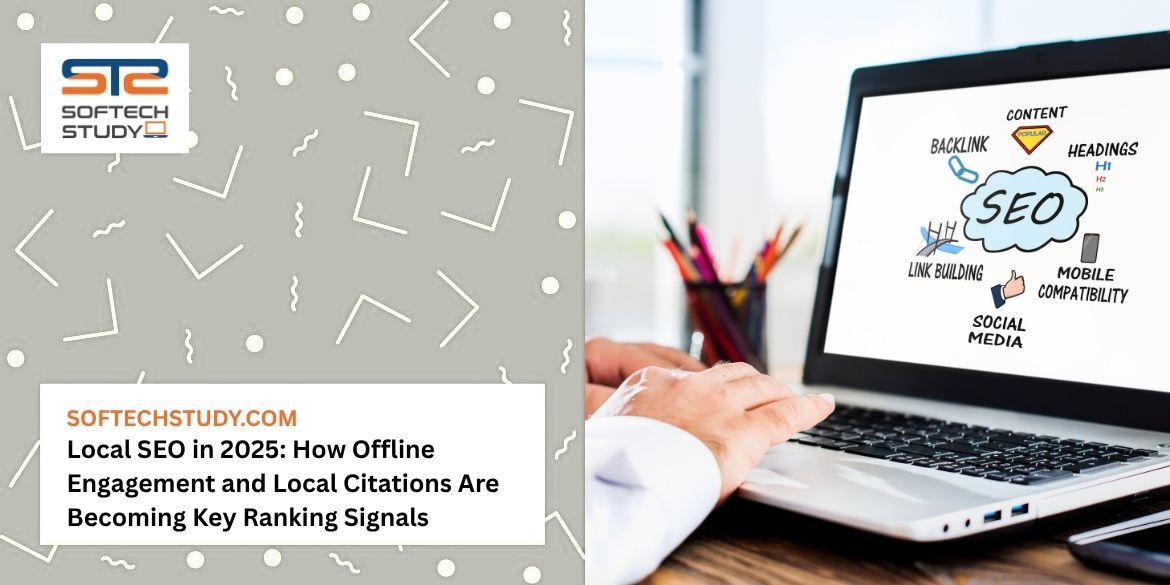
Local SEO in 2025 is more than just your website. Discover how offline signals, such as reviews, citations, community involvement, and word-of-mouth, increase search engine exposure.
Before the internet, local companies advertised offline using conventional media like television, radio, and print. The advent of the internet then brought with it online marketing opportunities, including digital assets like Google Business Profiles, which drives Google Maps and Google local search, and websites.
Best practices for online SEO, such as researching keywords, creating content, and creating local company listings, have become crucial for online marketing and are now widely used.
Numerous local firms have effectively transitioned from offline marketing to effective online self-representation.
The 2004 advent of Google Maps was crucial in enabling local brands to transition from offline to online representation. Any qualified business could not be included in Google’s web directory for free, instead having to rely on paid advertisements in phone books.
Today, though, there is a renewed focus on offline authenticity due to the spread of local business listing spam, which involves creating entries for fictitious business locations and publishing phony reviews. Customers and search engines alike must have confidence that company names and locations are accurately portrayed online.
When customer safety and brand reputation are at stake, if you can demonstrate that your company is real and doing well offline, the in-person authenticity you cultivate can pay dividends online and elevate your marketing approach.
This post will show you how to generate offline signals that support the legitimacy of your web search engine optimization efforts. (Off-page SEO, which refers to digital marketing activities that occur on the internet but outside of your website, should not be confused with this.)
What is an offline signal ?
Anything that is not digital that influences customer behavior, broadens Google’s understanding of a company, or enhances the legitimacy of a business is considered an offline signal.
Here are a few instances of offline signals:
Reputable storefront signs
Taking phone calls under a brand name that corresponds to the title of your Google Business Profile
Payments with credit cards at your workplace.
Why offline signals matter now ?
Local SEO strategies have been stressing the value of online and digital marketing signals to support your brand for over 20 years. However, due to the fact that local companies, as well as the search engines and platforms that rely on them, face substantial challenges, there is currently a shift toward real-world authenticity via offline signals.
The following online indicators are utilized to direct SEO campaigns:
- Establishing a precise online presence on well-known platforms with essential company data, such as name, address, and phone number (NAP) Google Business Profile
- Adding regular and precise structured citations—local business listings—to local business indexes like as Bing Places, Yelp, and YP.com will increase the digital footprint of your brand.
- Increasing local rating, organic ranking, and authority through links from pertinent third-party websites
Today’s search engines and local companies confront the following difficulties:
- Spam in local business listings: Google Business Profile (GBP) and other similar environments are tainted with phony listings and reviews, endangering the trust that customers have in these platforms.
- AI collecting misleading local business content: AIs trained on this data will merely repeat unreliable information, maintaining a distorted picture of the business environment, if a bad actor has published fraudulent reviews or made bogus listings (both of which are prohibited in the US).
Google’s discovery of a single company that produced 10,000 phony listings is one example of how GBP frauds garner media attention. According to a recent study, review fraud in the home, legal, and health services industries costs US consumers $300 billion a year.
The ability of scammers to build Google Business Profiles for fictitious business locations is a major issue.
For instance, a dubious garage door repair business may assert that it has a showroom at a specific address, but upon closer inspection, this is revealed to be a blank field.
Google, on the other hand, may interpret this in data gathered through its Streetview cars and other means when a company has obvious real-world signs on a real storefront. In order to verify that a company location is authentic, Google can also gather data on foot traffic, location, WiFi, and point-of-sale information.
Foot traffic and location data:
Google uses a mix of technologies to locate or approximate user location and movement. Google can track consumer behavior in local search settings using:
- GPS signals
- Sensors that measure position and velocity, such as the accelerometer and gyroscope
- Mobile network signals
- WiFi signals
When device users let Google to access their location data, Google uses that data to populate GBP elements such as “Popular times,” “Visit duration,” and “Wait estimates.” Looking back to our hypothetical phony garage door showroom in an empty field, it’s simple to understand how having these basic signals of real-world consumer behavior might reinforce validity in Google’s eyes—it’s unusual for a non-location to have popular times.
Wi Fi and network presence:
Google’s data collection via mobile and WiFi technologies can help distinguish a legitimate firm from a fraudulent one. Google indicates:
“Mobile and Wi-Fi network signals can help Android estimate the device’s location, especially in environments where GPS signals aren’t available or accurate, including in dense urban areas or when indoors.”
Point of sale and transactions (indirect signals)
Google tracks customer credit card transactions, providing confirmation that sales are taking place at a certain location. Furthermore, when store apps interact with services such as Google Analytics, Google gains access to this data.
There is a clear correlation between transaction volume, consumer activity, and the existence of a firm, but these signals do not necessarily indicate a brand’s trustworthiness. Scammers can also accumulate a large number of these metrics.
Local media, sponsorships, and offline mentions
Structured citations refer to any online mention of a local business that is indexed by Google. They are becoming increasingly relevant since they attest to the legitimacy of real-world companies.
For instance, when it reaches local headlines that a siding firm has donated both labor and supplies to fixing up the city hall, Google can index organized citations like these:
Sources of Organised mentions may include:
- Local sponsorships for events, teams, and organizations
- Hosting and taking part in community events.
- B2B cross-promotion agreements on local company websites.
- Being mentioned or contributing to hyperlocal blogs, podcasts, and video channels.
- Establishment of scholarships
- Advertising or being cited by local newspapers, radio, or television
- Social media mentions and forum conversations.
Any online record of offline company action increases entity trust. Google instructs its Quality Raters, who determine whether relevant results are returned to searchers, to explore a range of sources to better understand business reputation. Consumers may also face structured citations.
Clearly, a non-existent business is unlikely to participate in a promotion such as promising to paint the local city hall.
User-generated proof
While reviews have become a primary target for fraudsters in the local business sector, there are various factors that can improve the integrity of this information, including:
1.Photos are added in reviews to prove that a client visited a store or hired a company for a service.
2.Videos of customers visiting places, retail premises, inventory, employees at work, or finished projects are included in reviews.
3.Handwritten testimonials collected directly from clients by the company, adding an authentic, personal touch.
4.Social media location tags on platforms such as Instagram, TikTok, and Facebook link social media posts about local businesses to particular geographic places, such as going to a #cupcakebakery in #San Francisco.
Signals like this not only increase consumer trust in the validity of brands, but they also help Google grasp the authenticity of local institutions.
The way search engine crawlers acquire and analyze offline data:
Search engines such as Google have enormous data pipelines for tracking consumer movements, behaviors, and transactions. This occurs through a combination of:
- Mobile carriers
- Android/iOS signals
- Location tracking and aggregator partnerships.
- Google Analytics captures data and uses it behind the scenes.
Make the online experience more beneficial.
- Help searchers recall places they’ve already gone.
- Display anonymous community patterns, such as popular business times.
While the private nature of Google’s algorithm makes it difficult to claim that user or company data has a direct impact on local results, such data can clearly suggest that a business location exists and is frequented by the public.
Google focuses on ground truth for local entities:
Multiple Google patents and patent applications aim to link search queries to specific results based on human activities. This is all part of Google’s endeavor to build an online reflection of the real world.
For example, one patent is concerned with “inferring geographic locations for entities appearing in search queries.” In this dynamic, Google discusses the use of geolocation signals to connect internet content to real-world items such as buildings and landmarks.
Matching offline behavior to digital signals-
Google can cross-reference various data pieces.
For example, suppose a company develops a Google Business Profile for “Vegan Pizza Pan,” located at 600 Market Street in downtown San Francisco. A Google Streetview car then drives through the neighborhood, capturing images of an establishment with the sign “Mike’s Pizza.”
This poses a dilemma for Google (and customers): Is “Vegan Pizza Pan” the same as “Mike’s Pizza?”
Assume Google calls the business and a staff member just responds, “Mike’s.” To confirm the location’s true name, the Google representative will need to ask additional questions.
If the listing is stopped because Google is unsure about the name, the owner will be required to provide evidence (such as business licenses and tax certificates) proving that the entire legal name of the business is “Mike’s Vegan Pizza Pan.”
All of that difficulties could have been prevented by maintaining consistency in offline branding.
Tactics for increasing your offline authority online
Google has gotten so good at interpreting image content that it can now group photos.
Consider this scenario of a GBP photo set divided into over a dozen image categories:
Encourage reviewers to incorporate photographs in their reviews using the following tactics:
1.Create a photogenic brick-and-mortar location. Take a look at the visually appealing restaurant mentioned in the reviews above: It’s a site that customers appreciate photographing due to its attractiveness.
2.Create in-store signage that informs customers that you would like them to photograph and review your store.
3.Designate selfie hotspots to encourage people to photograph themselves at your business.
Update your review request templates to include a particular request that clients contribute photos while reviewing you.
4.Send images to consumers of service area companies (SABs), such as contractors, landscapers, and interior designers, displaying before-and-after shots or finished projects. Ask customers to include these photographs in their evaluations.
5.Experiment with submitting product and service photos as part of your review requests, but make sure the images are unique and do not come from manufacturers, or your reviews will appear suspicious rather than genuine.
6.Share customer-submitted images on your social media pages, providing socially active customers a another motivation to photograph your business.
7.To vary your proofs, ask some customers for handwritten testimonials at the time of service. Publish this content on your website as GBP Updates posts, owner-uploaded GBP picture content, and on your social media accounts.
Leverage local PR and community connections.
Doing well in a community can send significant signals of authenticity.
Earlier, we looked at an example of a siding firm renovating a local city hall. Almost any local business can acquire similar PR by taking the following steps:
- Plan to give back to the community by hosting or participating in events, donating to important institutions or local causes, sponsoring projects or sports teams, or creating another type of benefit.
- Reach out to the necessary parties: For example, call your local no-kill animal shelter and ask whether it would be beneficial to donate 5% of your sales during the holiday season. Perhaps they are going to take the offer.
- Reach out to local media with your story. This could include local reporters, bloggers, podcasters, video channel hosts, and so forth. Give people something to talk about on their never-ending quest for new and fascinating local content.
- Once articles about your community benefit program are online, publish them on your website and social media profiles to increase the likelihood that they will be noticed by the community and indexed by Google.
- If a project has an end date, schedule a time to begin your next community involvement initiative and repeat the process.
- A single program might earn your company several structured citations, demonstrating the genuineness of your engagement in the community and distinguishing you from dishonest competitors.
Assessing the impact of offline signals-
How can you know whether your efforts to demonstrate authenticity are yielding results? Track these four patterns to see how real-world activities influence online growth.
Google Business Profile performance improves through customer service enhancements.
The most straightforward offline-to-online key performance indicator (KPI) that any local firm can track is the influence of customer service on consumer ratings and review sentiment.
According to a significant review poll conducted by GatherUp, 60% of users are encouraged to leave negative evaluations in order to notify their communities about terrible experiences.
Only 24% will prefer to do business with a business that has an average star rating of three stars.
If your organization has entered the 3-star danger zone, you can track the outcomes of user experience enhancement projects using:
- Increased the number of reviews. According to the same survey, the most important motivator for reviewers is to reward positive customer experiences.
- Increased positive sentiment in reviews since your new campaign. Sort GBP reviews using the “newest” tab to examine sentiment over a certain era.
- A gradual improvement in your average GBP star rating.
- Increased conversions when your average rating improves and your most recent reviews reflect favorable consumer experiences. This can involve more inquiries for driving directions, calls clicked on, and clicks-to-website from your GBP, as indicated by the Performance tab in your fresh Merchant Experience dashboard.
- More revenue due to higher GBP conversions.
- Higher Local Pack and Maps search positions as an effect of better star ratings, review current status, and review volume, many of which are potential rankings signals.