

Search engine optimization PPC as high CTRs don’t always mean success. fastening on good clicks and print- grounded criteria can lead to stronger ROI and conversion rates. Numerous PPC advertisers in Search engine optimization PPC obsess over click- through rates, using them as a quick measure of announcement performance.
But in Search engine optimization PPC, CTR alone does not tell the whole story – what matters most is what happens after the click. That’s where numerous juggernauts go wrong in Search engine optimization PPC.
The problem with chasing high CTRs
Most advertisers believe that the ad with the greatest CTR is typically the best in Search engine optimization PPC. It should have a high Quality Score and generate a lot of clicks.
However, in most circumstances, lower CTR advertisements outperform higher CTR ads in terms of overall conversions and income within Search engine optimization PPC campaigns.
If I only cared about CTR in Search engine optimization PPC, I could write the following ad:
- “Free money.”
- “Claim your free money today.”
- “No strings attached.”
That ad would have a high CTR for numerous keywords, and I’d run out of business rapidly by giving out free money.
When developing advertisements, we must consider:
- The type of searchers we wish to attract.
- Ensure that users are qualified.
- Set your expectations for the landing page.
I can take my free money advertisement and modify it:
“Claim your free money.”
“Explore college scholarships.”
“Download your free guide.”
I now have:
- I informed searchers that if they downloaded a guide, they may receive free college money through scholarships.
- I narrowed down my target audience to persons Who are willing to apply for scholarships and download a handbook, probably in exchange for some information.
If you only focus on CTR and ignore recruiting the correct audience, your advertising will suffer.
While this concept applies to both B2C and B2B organizations, B2B companies must be particularly mindful of how their adverts appear to consumers versus business searchers.
B2B companies must pre-qualify searchers
If you are advertising for a B2B organization, you will frequently observe that CTR and conversion rates are inversely related. As CTR grows, conversion rates fall.
The most typical explanation for this phenomena is because consumers and organizations can search for several B2B keywords.
B2B enterprises must demonstrate that their products are for businesses, not consumers.
For example, “safety gates” is a frequently searched term.
The bulk of people wanting to purchase a safety gate are those who want to keep dogs or babies out of rooms or off staircases.
However, safety gates and railings are essential for organizations with factories, plants, or industrial sites.
These two advertisements are for companies that sell safety gates. The first ad headlines for Uline could be for a consumer or a company.
It isn’t until you read the description that you learn this is for mezzanines and catwalks, which most people do not have in their homes.
Because many searchers skip over descriptions, this ad will appeal to both B2B and B2C users.
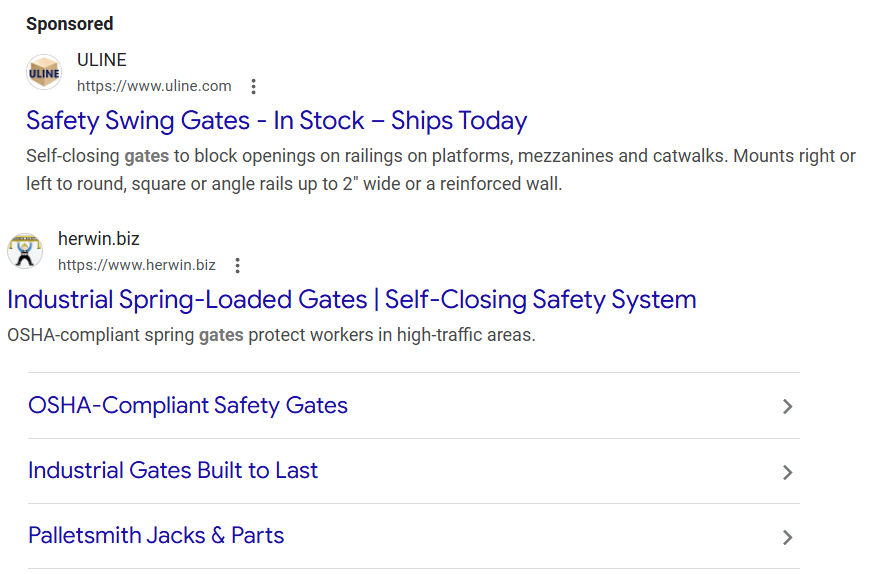
The second ad cites Industrial in the headline and then OSHA compliance in the description and sitelinks.
While both commercials sell identical products, the second one will have a higher conversion rate because it addresses a specific audience.
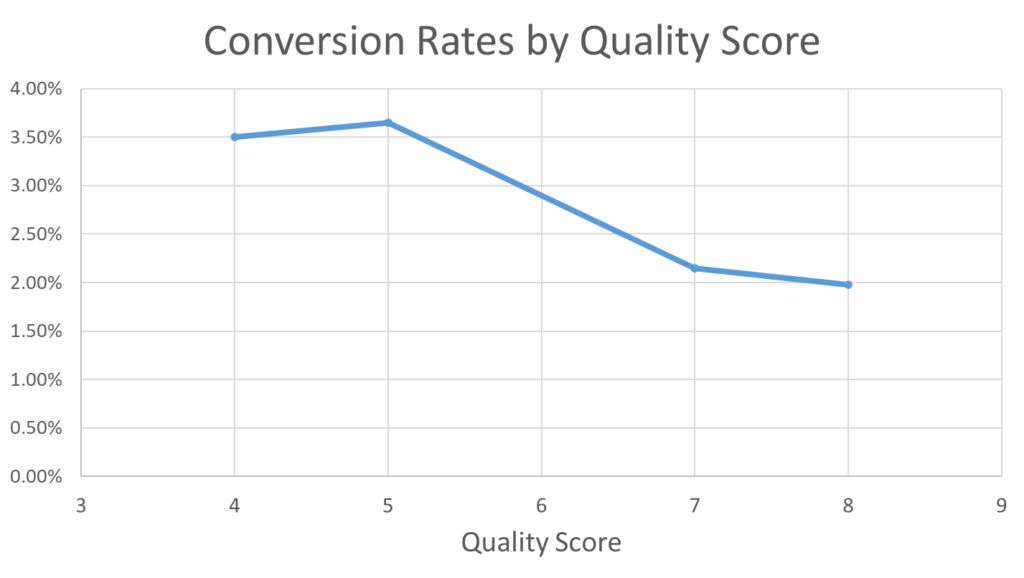
We have a client who specialized in factory parts, and when we graph their conversion rates by Quality Score, we can see that as Quality Score rises, conversion rates fall.
They will review their keywords and advertising anytime they receive a 5+ Quality Score on any B2B or B2C term.
This rationale is not applicable to B2B search phrases.
When searching for B2B services and products, these terms frequently include additional jargon or qualifying statements.
B2B advertisers are not need to employ characters to filter out B2C consumers and can instead focus their ads just on B2B searches.
How to balance CTR and conversion rates
Examining the stats while testing different ads to discover the best pre-qualifying phrases might be difficult. Which one of these would be your finest advertisement?
15% CTR and 3% conversion rate.
10% CT and 7% conversion rate.
5% CTR and 11% conversion rate.
When analyzing mixed data, such as CTR and conversion rates, we can use extra metrics to identify our top ads. My favorites two are:
Conversion per impression (CPI) is a simple method for dividing your conversion by the number of impressions.
Revenue per impressions (RPI): If your checkout amounts vary, you can utilize your revenue measurements to choose the ideal advertising by dividing your revenue by your impressions.
Instead of dealing with a large number of decimal points, multiply the results by 1,000 to make them easier to understand. So, we could write:
CPI = (conversions/impressions) x 1000.
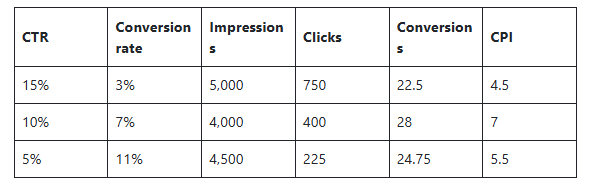
Using impression metrics, you can determine the opportunity for a specific set of impressions.
Focus on your ideal clientele.
A high CTR attracts more visitors to your website, increases audience size, and can influence your Quality Scores.
However, high CTR ads might easily attract the wrong audience, causing you to waste your money.
Think about your target demographic while crafting headlines.
- Who are they?
- Are non-audience members searching for your keywords?
- How can you keep users who aren’t in your target audience from clicking on your ads?
- How do you attract a qualified audience?
- Are your advertisements creating appropriate landing page expectations?
Consider each of these questions as you design advertising to ensure that they speak to the type of users you want to attract to your site.
These ads rarely produce the highest CTRs. These ads strike a compromise between the attractiveness of high CTRs and pre-qualifying claims, ensuring that the clicks you receive have the potential to become your next customer.